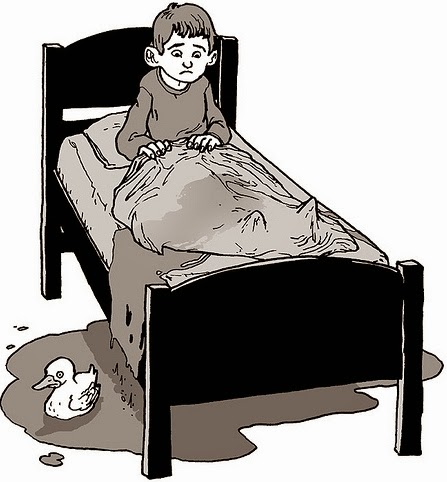
Bed wetting
Bedwetting, or nocturnal enuresis, refers to the unintentional passage of urine during sleep. Enuresis is the medical term for wetting, whether in the clothing during the day or in bed at night. Another name for enuresis is urinary incontinence.
Types of bed wetting
Two types of bed wetting occur:
- Primary enuresis — bed wetting since infancy; and Primary bed wetting is generally viewed as a delay in maturation of the nervous system. Family history plays a big roll in predicting primary bed wetting. If one parent was a bed wetter, the offspring have a 45% chance of a developing primary enuresis as well. At 5 years of age, children wet the bed at least once a month both males and females wetting nightly.
- Secondary enuresis — wetting developed after being continually dry for a minimum of six months. Urinary tract infections, metabolic disorders (for example, various types of diabetes), external pressure on the bladder (for example, extreme constipation by a large rectal stool mass), as well as neurological disorders of the spinal cord must be considered among the causes of secondary bedwetting.
Causes of bed wetting:
There are various causes of bed wetting that are listed below:
There are various causes of bed wetting that are listed below:
- Psychological causes: When the child is stressed, then the incidence of bed wetting can increase. This can occur when the child starts going to school or when the parents either separate or have a divorce. These stressful events can cause bed wetting in children.
- Anatomical causes: There can be malformations in the genito urinary system that can also lead to bedwetting in children.
- Development problems: When the child has diseases like Down’s syndrome or Attention deficit disorder, there can be an increased incidence of bedwetting in such children.
- Diseases: Bedwetting can also occur if there are diseases where there is excess production of urine. This is very common in diseases like Diabetes. It can also occur in conditions like urinary infection where bedwetting increases.
- Other causes: There can also be other simple causes like:
- Increased intake of fluids before sleeping.
- When the child is in a deep sleep, there can be bedwetting.
- Oversleeping can also cause bed wetting.
Prevention of bed wetting:
Psychological support and preventing the child from being stressed can help in preventing the incidence of bed wetting in children.
Treatment for bedwetting:
There are various treatments for bed wetting, but most of these treatments depend on the cause of bedwetting. Homeo treatment controls the cause and relieves the effect which is bed wetting.
There are various treatments for bed wetting, but most of these treatments depend on the cause of bedwetting. Homeo treatment controls the cause and relieves the effect which is bed wetting.
- Counselling: The child needs counselling to reduce stress. Parents need counselling to support the child and not scold the child. This is one of the major treatments for
bedwetting. - Correction: Correction of the genito urinary malformations will also help in reducing the incidence of bed wetting.
- Diseases: Treating the diseases like diabetes and urinary infection will also help in reducing the incidence of bedwetting.
- Medications: There are medications available that can help to control bed wetting. Symptomatic Homeopathy medicines help to control bed wetting
 Practical tips: There are also some practical tips that can help in reducing and also preventing the incidence of bed wetting. This is to control the amount of fluid intake. Once there is a decreased intake
of fluids in the night, then there will be decreased production of urine.
Another thing that can be done is to have the toilet near the bedroom of the child or having a potty in the room itself to help the child to prevent bed wetting.
Whom to contact for Bed wetting Treatment
Vivekanantha Clinic Doctors treats many cases of Bed wetting problems for girls and boys, with successful results. Many patients get relief after taking treatment from Vivekanantha Clinic. You can meet the Doctors at Vivekanantha Homeopathy Clinic, Velachery, Chennai 42. To get appointment please call 9786901830, +91 94430 54168 or mail to consult.ur.dr@gmail.com,
For appointment: SMS your Name -Age – Mobile Number – Problem in Single word – date and day – Place of appointment (Eg: Rajini – 13 – 99xxxxxxx0 – bed wetting, passing uring in bed, night wetting in bed, – 21st Oct, Sunday – Chennai ), You will receive Appointment details through SMS
For more details & Consultation Feel free to contact us.
Vivekanantha Clinic Consultation Champers
at
at
Chennai:- 9786901830
Pondicherry:- 9865212055
Panruti:- 9443054168
For appointment please Call us or Mail Us
bed wetting homeopathy treatment chennai, passing urine in bed treatment chennai, child passing urine in bed, bed wetting treatment for girl in chennai, படுக்கையில் சிறுநீர் கழித்தல் ஹோமியோபதி சிகிச்சை, பெட்வெட்டிங் ஓமியோ சிகிச்சை தமிழில், பெட் வெட்டிங் சிகிச்சை ஸ்பெசலிஸ்ட் சென்னை,
==–==
Feel Free to Contact us